

From Stress to Inner Strength: How Leaders Can Reduce Stress and Prevent Burnout
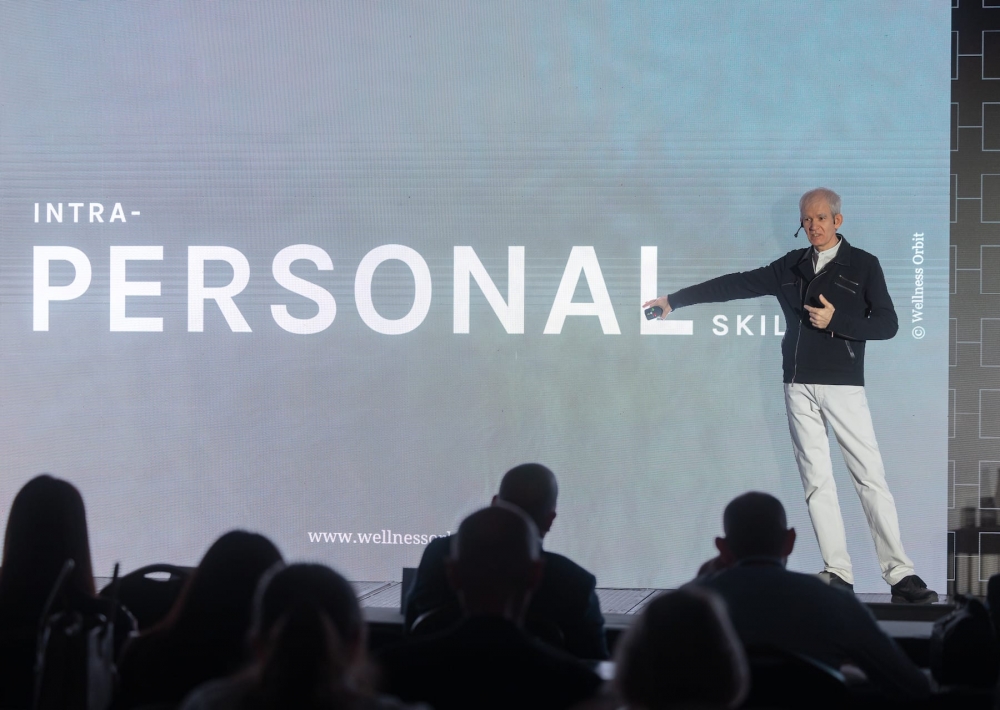 Kaur Lass: Everyone needs excellent intrapersonal skills
As Stress Awareness Month continues, it’s time to move beyond simply acknowledging stress and start tackling it meaningfully.
At the leadership level, it is crucial to actively observe and identify where, in the daily flow of work, employees are experiencing the highest levels of consistent and preventable stressors. By pinpointing these recurring pressure points, leaders can take targeted action to reduce unnecessary strain, protect mental wellbeing, and safeguard both individual performance and overall team productivity.
Stressors Can Trigger Stress
Stressors and stress aren't the same. Understanding the difference between the two is crucial for securing inner calmness and lasting mental wellbeing.
Stressors are external pressures that originate outside the individual. They include tight deadlines, excessive workloads, cumbersome procedures, inefficient tools or systems, and challenging conversations. Even inconsistent or unclear leadership can become a major stressor.
Many of these stressors are actually “workflow design flaws” rather than inevitable. Reducing such external factors and improving the work design certainly helps and can often lower the overall tension that employees face. The fewer stressors there are, the better.
However, there are also stressors that the employer can't help. Such stressors are economic downturns, new taxes, sudden changes in market situation due to what competitors do, regulations, etc. So, removing all stressors is impossible.
However, stress itself is, in essence, different from stressors.
Stress is always your own inner subconscious reactivity: the way your mind reacts (and this reaction influences your physical body) to those pressures through worry, rumination, tension, anxiety, or other forms of overwhelm.
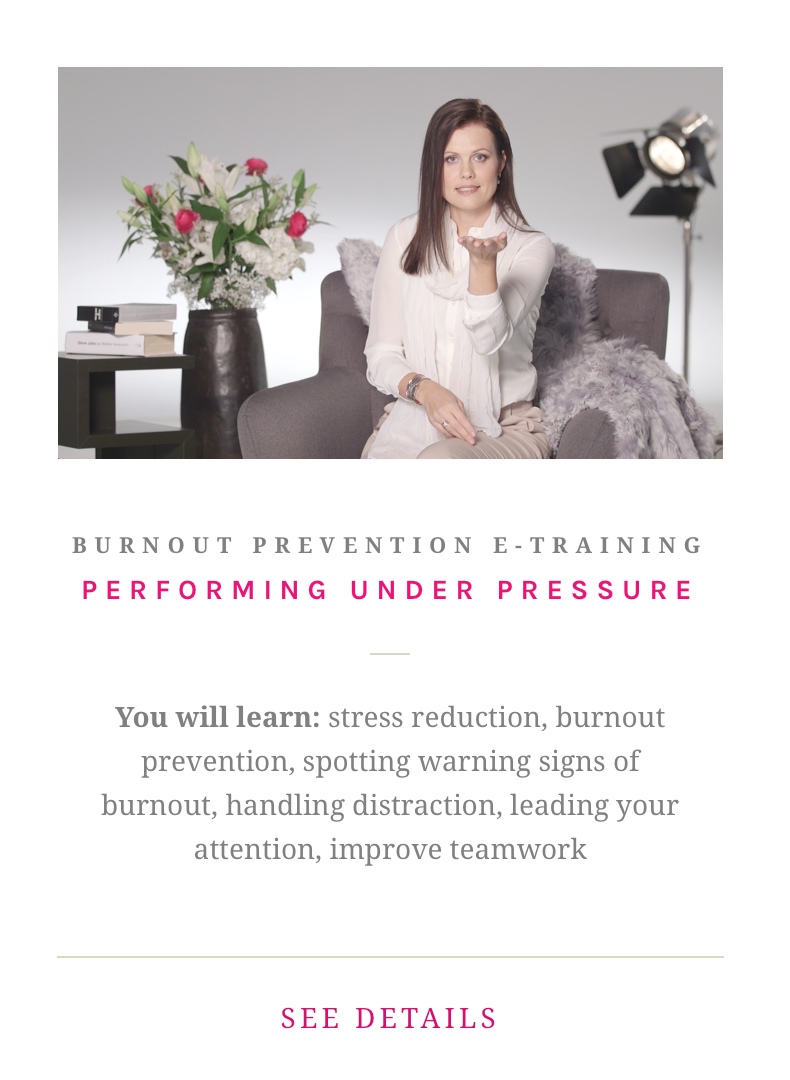
Personally sustainable stress reduction, therefore, requires more than just removing stressors. It demands good intrapersonal skills. It demands inner calmness and intrapersonal skills to perform well in all situations, and for this, we offer online training "Performing Under Pressure".

When you can become aware of your inner reactions in the moment, pause, and replace your subconscious reaction with a conscious choice, you gain inner freedom. Taking full responsibility is what gives you the inner freedom to consciously guide your thoughts, imagination, emotions, and physical behaviors.
Training Intrapersonal Skills as a Solution
By training intrapersonal skills, you achieve self-leadership. Learning intrapersonal skills while you are still well will allow you to stay calm, even when stressors around you appear.
Training your mind to remain calm and possessing good intrapersonal skills allows you to protect both performance and mental health in the long run.
When people have trained their minds and retain good intrapersonal skills, you also need to look at how clearly employees understand what truly matters in their role.
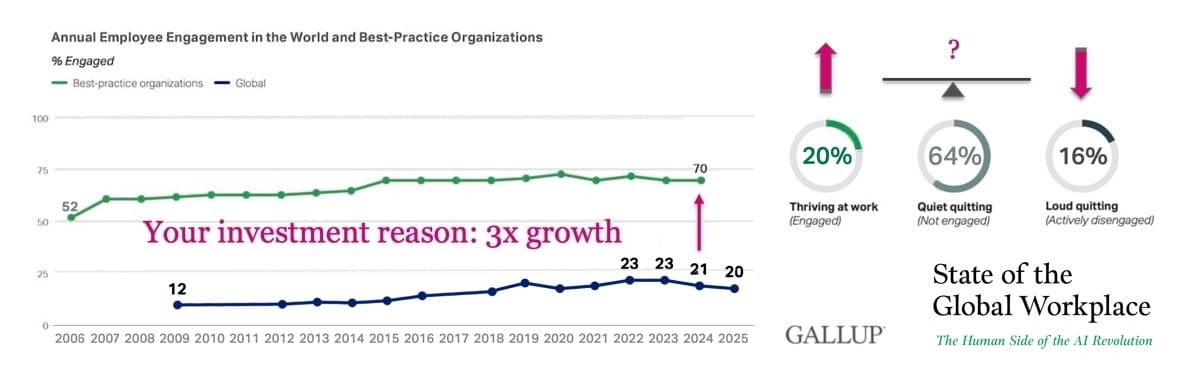
When you notice what can be removed, you can change old or habitual patterns that drain your energy level. Such hidden strain is incredibly costly to employee engagement and retention levels; thus, only 20% of employees are fully engaged (see the graph based on the 2026 Gallup Report below).
Stop normalizing stress
It is wise to ask to what extent you are normalizing high stress as you stick to the paradigm, “This is how things are done.”?
What we accept as normal tends to persist and spread. While intrapersonal skills allow efficient stress reduction, interpersonal communication and honesty are needed to improve the work environment and workflow.
When people have good intrapersonal leadership, communication becomes more open-minded, honest and simple. People stop searching for hidden agendas and start to understand what the actual point was. Inner reactions don't allow this; conscious response, however, does permit radical open-mindedness and allows trust to become a norm.
7 aspects that allow a stress-free workplace
A work environment where people can develop their intrapersonal and professional skills to the fullest demands:
- Conscious leadership from leaders and self-leadership, and taking personal responsibility from everyone involved.
- Access to intrapersonal skills training, as most people have a very vague understanding of their inner powers.
- Practicing awareness-based intrapersonal skills in all situations as much as possible. When you do that, you will notice the power of intrapersonal mastery and then adjust your actions according to the situation and lessons learned.
- Radical open-mindedness, as the subconscious processes and inner reactions block/reduce our awareness and ability to use intrapersonal skills. People with low-level intrapersonal skills fail more often, but it is just an opportunity to learn; they should be directed and supported, not judged and punished. Honest support and honest learning make all the difference here. Everyone should be able to speak about what they observe, give honest feedback, and focus on how to improve things and solutions.
- Kindness and forgiveness towards those who make mistakes, as all failures are just lessons to be learned. No failure is permanent until we try again, so solving challenges needs to be kindly encouraged and always firmly supported. Of course, this doesn't mean that you have to tolerate sabotage and active disengagement that endangers your team's reputation.
- Gratitude towards the ability to learn and those who support your learning process, as well as gratitude towards yourself as a learner.
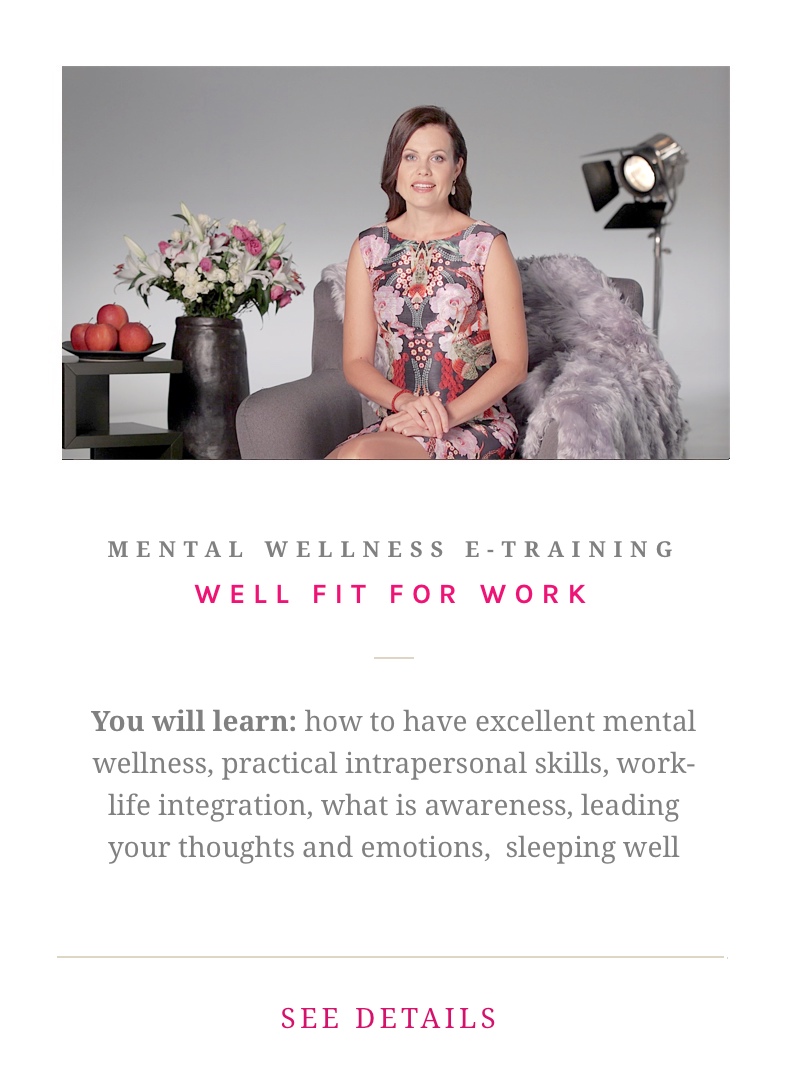
- That people have fit minds, as it is hard to stand pressure if you are stressed and anxious. While intrapersonal skills are the foundation of mental wellness, only the skills that you apply can make a difference. So, a proactive mental wellness approach is a must as it is all founded upon personal initiative and based on conscious responding instead of subconscious reactivity.
When you train your mind and learn intrapersonal skills, we are sure you can strive for such a great work environment.
The leader's role in stress reduction
One of a leader’s most important responsibilities is to proactively spot the early signs of stress in their teams and respond to them swiftly and effectively. By recognizing subtle indicators, such as increased irritability, withdrawal, reduced engagement, or changes in performance, leaders can intervene before stress escalates into burnout, anxiety, or disengagement.
Engagement levels across leadership levels last year can be seen on the Gallup graph below.
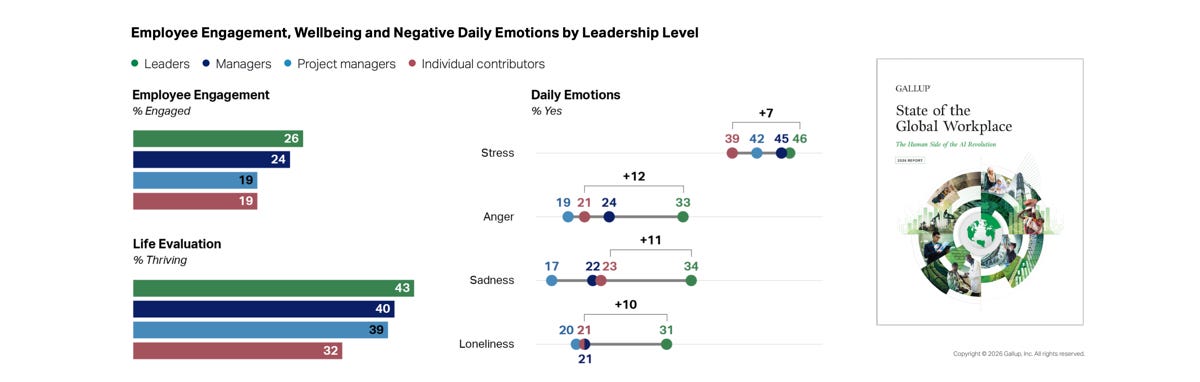
According to this year’s Gallup report, State of the Global Workforce, “When comparing leaders, managers, project managers and individual contributors, higher levels of leadership report higher levels of engagement and wellbeing. At the same time, compared with individual contributors, leaders are substantially more likely to report experiencing a lot of stress (+7 points), anger (+12), sadness (+11) and loneliness (+10) the previous day.”
The proactive mental wellness approach protects team wellbeing and boosts productivity, morale, and talent retention.
Leaders and mid-level managers are the frontline of both stress prevention and, unfortunately, also stress creation. It is the leader's task to notice what operational patterns, like errors, rework, delays, or communication breakdowns, reveal the hidden cost of stress.
If you removed all unnecessary complexity, urgency, and ambiguity from your workflows, how much stress could be eliminated without reducing output?
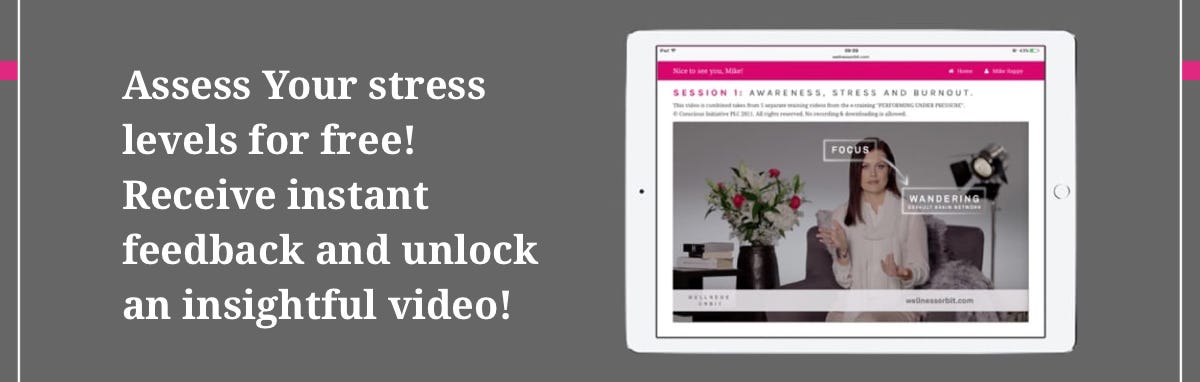
Both individual coping skills and structural improvement matter. They show that efficiency and wellbeing aren't in conflict, when done consciously, reducing stress and improving performance go hand in hand. To know your stress level, take a free stress test below.
Stress and burnout connection
If you are too often busy, caught in your own inner reactivity, you sooner or later feel depleted and disconnected due to stress. Instead of being present and focused, your mind runs wild, on a speedy autopilot, flitting from task to task, worrying to worry, without pause.
This constant mental overdrive, coupled with an already packed schedule, creates a recipe for overwhelm and chronic stress that then slowly turns into burnout. It's not a sudden event; it's a slow descent from stress into burnout.
No one wakes up one morning completely stressed and exhausted or burned out. It's a gradual erosion, a slow accumulation of unaddressed pressures and a persistent lack of inner calm.
Failure to reduce stress, in the end, has a high financial cost for employers, as it leads to burnout of both leaders and employees.
The scientific paper 'The Health and Economic Burden of Employee Burnout to U.S. Employers' published in April 2025 by the American Journal of Preventive Medicine proved that employee burnout costs range from $3,999 to $20,915 (3,333€ to 17,429€ or £2,999 to £15,686) per person.
In comparison, your investment for a 6 to 8 hour stress reduction and burnout prevention e-training per person is never higher than £81 ($108 or 90€), and you can take in 5 sessions (total training time depends on how thoroughly you use your workbook to make a personal development plan).
Best of all, you evaluate your stress and burnout situation both before and after the training and can see if your initial estimation was correct or wrong.
Often, your busyness becomes a badge of honor, a symbol of your worth, when in reality, it's often a way to avoid confronting your own stress and inner turmoil. This is what is leading you towards burnout, as you lack intrapersonal skills for self-monitoring and self-leadership.
When you remove relaxation and lack awareness to notice your inner reactivity, you tend to lose your inner calmness; there is no space for rest or simply being fully present.
When your mind becomes cluttered with to-do lists and anxiety, it prevents you from experiencing the present moment. Thus, you lose contact with your True Self and fail to notice the Joy of Life
We invite you to pause and train your mind. We invite you to restore your inner calmness. Then you and your team can audit stressors, remove all inner reactivity, and work as a team of more conscious people.
Conclusion
It is time to step out of the reactive inner patterns and learn intrapersonal skills for conscious choices. Reclaiming your inner calm is a necessity for preventing the trap of chronic stress and burnout.
Remember, no stress is healthy in the long run. The slow path from positive stress to chronic stress and then burnout is what makes burnout 100% preventable.
It is time you commit to prioritizing your mental wellness proactively.
|
This stress awareness month blog post is shared by Kaur Lass