Intuition is often seen as something mysterious. In reality, accessing intuition is a disciplined intrapersonal capability that you train and then use for your conscious decision-making.
To explain intuition with more precision, you need to understand consciousness as an active, directed awareness you can use at will.
Awareness of awareness and sensing are the silent inner tools you can use while staying fully present in your human body.
Rather than looking at a situation through a linear mental logic or seeing it as a fixed plan-based sequence of steps, you evaluate it through sensing and becoming aware of the topic, while keeping a calm and serene mind. It is knowing how to secure inner calmness that is the key to accessing intuition.
A noisy mind blocks intuition. All your thoughts, imagination, and emotional patterns are learned subconscious reactions. Those re-activate the known based on previous experience.
When your mind is triggered by stressors (among other things), you aren’t fully present and often get lost in your mental and emotional processes. The more emotional turmoil you experience, the less rational you become. That is why AI is useful, pure data analysis, no emotions, but AI has zero creativity and intuition.

In today’s world, AI systems analyze the mental side much faster than any human can. However, AI can’t access intuition or creativity. All programs, including AI models, use the numbers 1 and 0 as the very base of their code.
Consciousness, however, is equally in 1, 0, and the space in between those two numbers. Consciousness is. It is everywhere. Using intuition and creativity means knowing how to access consciousness; it isn’t based on thinking or imagination.
Thinking blocks creativity and intuition
The primary blocker of creativity and intuition is typically thinking. When your thoughts run on autopilot mode, there is no room for those subtle and silent levels.
Creativity and intuition are awareness-based intrapersonal skills, accessed through inner silence and being fully present.
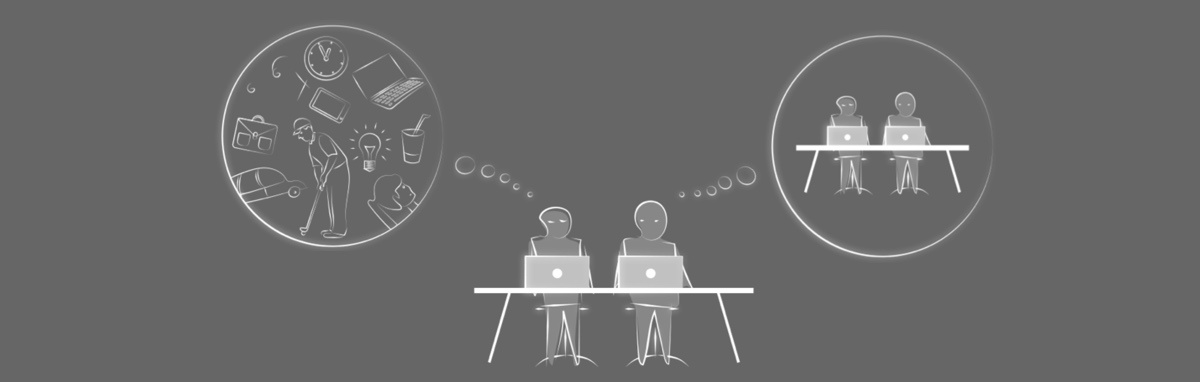
As humans, our minds are often in turmoil; we imagine and think about things that aren't relevant at all (see the left-hand side of the image above). Purposeful action is conscious, and purposeful thinking is aligned with your focus and relevant to what you do at any given moment (the person on the right-hand side of the graph).
However, what you need to understand is that thinking is always a mental process based on something we have heard/seen/learned. That is why AI needs to be trained with data and why it is a large language/data-based solution.
AI can only analyze the known and notice patterns and recombine the data/sentences/words. It is a combinative, not inventive solution.
There is a simple question to prove the point. Try to think of something that you don't know. Can you?
You can’t, just as AI can’t.
AI can make things up based on the known, but often those are general and wrong answers. That is why today’s AI solutions struggle with lies. Numerous unpredictable combinations may seem grammatically probable for the large-scale language model, but don't present the actual truth. AI can’t know what hasn’t been fed to it (during the training and data mining). It is the same with human thoughts.
You can only think of what you have seen, heard, read, or received in any other way.
However, when you are calm (in a state without thoughts and emotions), and your intuition and creativity are open, you can express yourself consciously, and the right words will appear to you. Those words that appear due to intuition then allow you to describe something totally new. This is how innovative ideas are expressed, no old thought-patterns, but instead new, creative, and precise descriptions of your insight and/or intuition!
How do creativity and intuition differ from thinking?
That is why there realistically is creativity, and there is thinking. There is also the use of intuition or relying on analytical thought patterns. AI is extremely good at the last ones. But has no idea how to access intuition. It isn't one or the other; it is about getting the best from both worlds.
Humans, however, can access intuition and then use words to express it, and thus new information appears.
In reality, if you understand how the human inner domain is built, there is no creative thinking.
AI needs to be either trained based on copyrighted data in an honest way, or it crawls the web and steals and combines what it machine reads. It can combine the known with its model (that is why different AI models give different answers to the same question), but it does not give you something new out of the blue.
Endless combinations of thoughts/words can seem new, but are in essence combining the old in surprising ways.
For example, the sentence: “Any data considered meaningful retains that designation across contexts.”, that is, an actual ChatGPT-generated sentence, sounds interesting but lacks any new quality compared to a simple human statement that “The quality of data matters”.
That being said, words can be used to describe new creative ideas or insights. When your creativity and intuition flow, writing or drawing becomes fun and easy. When your intuition guides you, and you can access creativity at will, you can come up with innovative approaches.
Creativity and intuition can only be accessed and flow in the moment.
Creativity can bring forth something surprising if insight gets involved. That is where the fun is!
In practice, you can formulate a quest and then calm your mind. When you drop all tension and know how to access creativity, insight, and intuition through inner silence, something new can appear to you.
The key is becoming silent inside. Knowing how to release all thoughts, imagination, emotions, fears, and desires can be very helpful in this case.
Only from your inner silence, which is being your True Self and fully conscious, can a creative idea or solution appear to you!
Tuning to intuition is a bit like catching the right radio station wavelength. When access is tuned in, and an eureka effect appears, you can find suitable words to describe it, sketch or draw it, or express it in some other way.
When leaders and professionals understand intuition through such a lens, it becomes clear that intuition is neither mystical nor optional.
Intuition is a practical and strategic component of effective leadership. Intuition and other intrapersonal skills are needed for innovations.
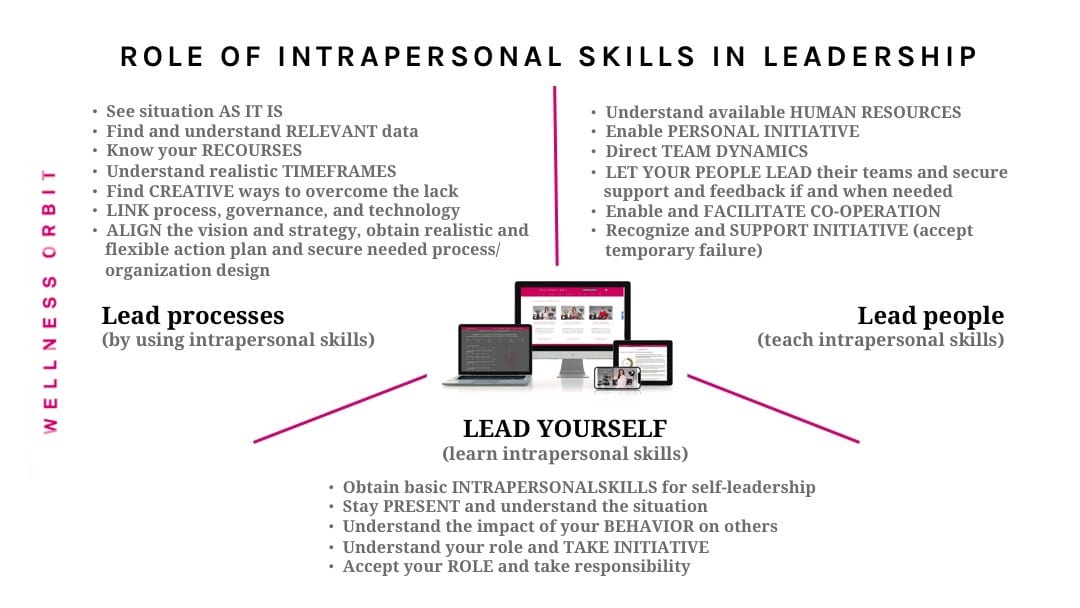
It is the self-leadership that allows you to be truly innovative and lead others and different processes around you.
Here is one story. Radiowaves existed and were used, but the signals were not secure. You needed Hedy Lamarr to get an insight. She showed true leadership during the Second World War and used her creativity for much more than just acting.
It is surprising to many that the famous Hollywood actor Hedy Lamarr discovered a method of secret communication that is relatively simple and reliable in operation, but at the same time is difficult to discover or decipher (U.S. patent 2,292,387 issued under her legal name Hedy Kiesler Markey), on which today's Wi-Fi networks are based.
While the US Navy rejected her idea at first, as they didn’t have the technology to use it for leading torpedoes, many years later, the needed electronic devices were invented, and now we all use it as a secure Wi-Fi network. For this, in 2014, Lamarr was posthumously inducted into the US National Inventors Hall of Fame for frequency-hopping spread spectrum technology. She was a remarkable woman who demonstrated the value of intuition, insight and creativity.
How Your Mind Really Processes Information
Most people assume their thinking unfolds in a straight line: one idea followed by the next. But your brain runs a multi-layered loop, where experience, emotion, context, and perception interact with thinking in real time. That is why the untrained human mind often loses its focus and purposeful thought patterns.
Purposeful thinking needs to follow an agreed focus and combine the previously learned data and patterns. That is why AI thinks thousands of times faster than any human brain; it has zero emotional impact. AI learns patterns and accesses data instantly. But it fails to see beyond the patterns and data.
That is why a conscious human being easily spots errors in AI data, and AI itself fails to notice its mistakes. As said, all current AI-based solutions combine known things (language, picture, or video-based data) in new ways, but fail to be creative or access intuition.
The advantage of the human being is that it has the inner power to work across multiple dimensions simultaneously. This is how you sometimes sense a risk before you can articulate it, or feel a direction is right even when data is incomplete.
While the human mind operates on the level of thoughts, imagination, and emotions, humans can also use awareness and sensing, as well as the physical body, which in turn has 5 different sense gates. We also feel fear and sense limiting powers such as anxiousness and desires. When you, as True Self, are fully present, all layers of your inner domain (see the image below) give you feedback.
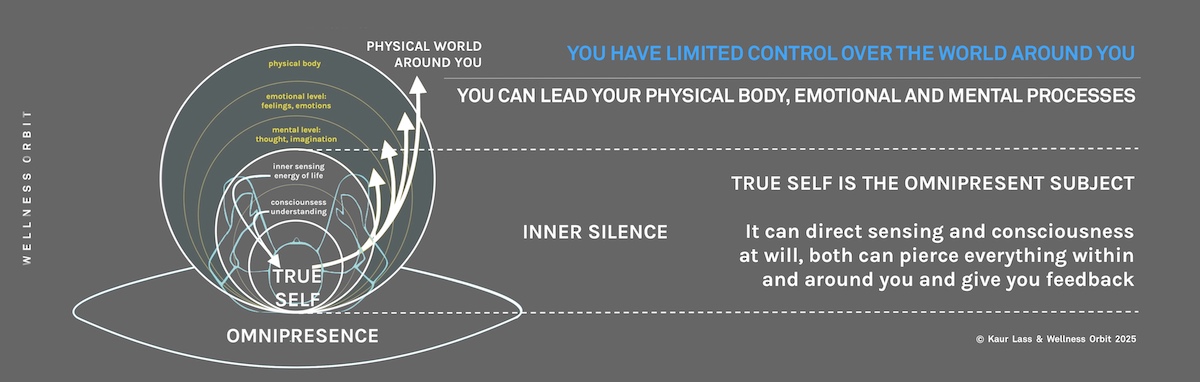
The human eye and insight can see, and you, as a soul in a human body, can sense far more than current sensors can. That is why Tesla Autopilot keeps failing to fully automate self-driving, especially in the Nordic climate, where the background and roads are all white during the winter. However, in closed factory settings where all is controlled, AI-based robotic systems operate already in the lights-out factory style successfully.
AI systems have their benefits in certain conditions, while humans are far from being replaced by AI in real-world situations. Why?
Your consciousness can access far more than your mind can access and express only through your mental level.
Intuition can be described as a coherent internal match between the present moment, what you sense and become aware of, which can include access to universally known but mentally unknown.
You, as True Self, are a soul, and you have a mind and physical body that you use as a human being.
We could say that intuition is soul-level access to what you need to spot, know or use, and it appears in a dimension beyond time (for you as True Self, time doesn’t exist). That is why intuition can be accessed only when your mind is calm, you are rooted in your body, and you truly need the data to help yourself or others.
When you keep your mind calm, your intuition and creativity enable you to connect the dots and see the big picture and details at the same time.
Understanding isn’t thinking. Understanding happens on the level of awareness and sensing (see the previous graph above) and is based on practical knowledge. That is why understanding may vary from situation to situation, as you can be aware of far more details than you can think of.
Inner Silence Enables Intuition
High pressure at work creates constant noise and loads of data. Today, we produce more terabytes of data than ever before. Most of it is noise, and only a small part of it is valuable. For example, most of the TikTok videos are just noisy entertainment, providing no actual value.
Only when your mind is silent, and you use intuition, can you distinguish the important from the less important.
During a typical workday full of messages, newsfeeds, data, and emotional turmoil, your attention becomes fragmented, your nervous system accelerates, and your capacity for calm, intuitive insight narrows. Stress and anxiety kick in. Soon, this stress becomes chronic and can lead to burnout.
Inner speed kills access to intuition and creativity. That is why lowering the stress and anxiety level matters.
Keeping inner calm is a key performance skill. Inner silence gives your mind the space to process complexity without overload.
When your mind remains quiet, even during busy periods and noisy events, your intuition and conscious understanding can surface with clarity rather than fighting through internal interference.
Leaders who cultivate calm workplaces and value inner silence can make decisions more fluidly, stay focused under stress, and maintain a steady emotional presence. They no longer react; instead, they calmly take responsibility.
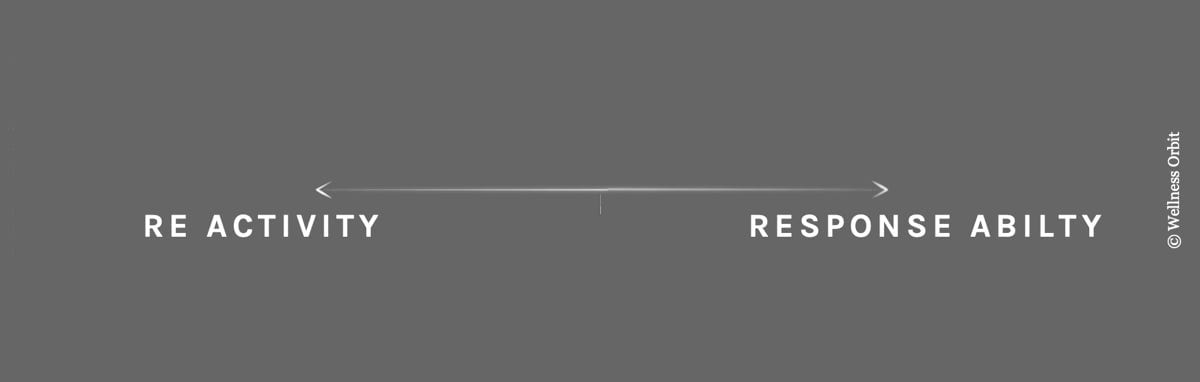
Human ability to respond is just conscious decision-making. Intuition plays a huge role in such decision-making. It doesn’t render data unimportant, but it looks behind the patterns and fills the missing caps with sensing and awareness.
Conscious response is an intrapersonal skill that is the foundation of securing your mental wellness. Keeping a calm mind and taking full responsibility for what happens in your mind gives you and your team members a sense of confidence. It is the very foundation of good interpersonal relations and psychological safety.
Leaders who rely only on data and mental analytical power or AI, without using their own inner silence and intuition, may fall behind as they do what everyone else is doing. They are part of the fast-paced race relaying data instead of humans with good intrapersonal skills who act consciously.
We all have seen the similarity in AI-written answers. There is no life, art, or other flowing and engaging creative aspects in such texts. Probably today’s school teachers spot AI-written texts better than AI itself, as pupils constantly try to avoid learning and using their own brains.
The downside of AI is that it needs to be trained as well. Otherwise, it may successfully combine stupidity with morally questionable data.
Intuition relies on ethics, morality, and culture as well as sensing of nature and other humans in a life-preserving way.
Provided, of course, that the person has a healthy mind and body, and acts with goodwill and morally sound intentions.
Intuition as a Competitive Advantage in Leadership
Most organizations correctly emphasize logic, data and evidence. Yet, leaders and professionals who rely on mental reasoning and logic alone restrict themselves and their teams.
All top experts can, after years in practice, know something intuitively. They see the unseen, both due to experience but also due to daring to take full responsibility and trusting the path.
Intuition has the power to expand your perceptual field beyond thinking, imagination and emotions.
It uses consciousness in the active form and benefits from intrapersonal skills.
Sensing and awareness are what help you detect misalignment in a negotiation or data. Your empathy is what allows you to sense tension in a team long before numbers reflect it. Your intuition allows you to notice early signs of market shifts, as something that can’t be shown only analytically is wrong in the big picture. Intuition often guides you in spotting patterns in group behavior or sensing fear or desire for power.
Most of such insights are fully intuitive; intuition and insights aren't codable or analyzable by your mind or AI.
It is the application of your consciousness and intrapersonal skills that allows understanding, which accelerates your decision-making.
The same intrapersonal skills that are needed for accessing intuition and creativity are also used to scan and evaluate your own inner domain.
This is what allows you to spot warning signs of stress and reduce burnout risk that comes from over-analyzing every detail and aiming for perfection.
It is training intrapersonal skills that allow you and your team members to improve self-leadership, thus it strengthens confidence because you understand that every human mind uses the same universal rules and principles on the subconscious level.
Once you start noticing reactive patterns, you see them not only in your own mind, but also around you. This prevents subconscious automatic repetition and mistakes.
Access to intuition enhances your relational intelligence. Leaders often describe moments when they “just knew” a person wasn’t ready, or sensed a partnership would flourish. These impressions come from consciously spotting the subtle, the tonal, and the unspoken.
When you maintain internal silence, you reduce friction in your thinking and reactive patterns. You stop being pulled by every stimulus, notification, or emotional signal. Instead, you respond calmly with conscious clarity.
Intuition and Mental Wellness
Leaders who suppress emotions and only demand mental analysis always experience more stress. They overthink, second-guess themselves, and carry an unnecessary cognitive load. This increases tension in both the mind and body, reducing resilience and elevating burnout and health risks.
By contrast, leaders who value calm mind, presence, and conscious decision making become proactive as they stop reacting and start leading. Due to this, their sense of taking responsibility for keeping focus strengthens. Their decisions gain coherence.
Mental wellness is foundational for having a fit mind.
A tired, overstimulated mind cannot access intuition, insights, or be creative. It just reacts and suffers more.
When leaders operate with clarity and calm internal alignment, employee engagement rises naturally as people follow their calm and conscious path. Teams observe your steadiness, your confidence, and your capacity to respond rather than react. This has a direct impact on work culture and decision-making patterns.
Employees feel safer when leaders demonstrate harmony and grounded presence. Performance can improve when leaders sense early signs of overload or disengagement and intervene proactively with care.
Intuition allows you to spot subtle warning signs of stress within your mind and in other people and their work patterns, and address them proactively before stress, burnout, and anxiety cause mistrust and structural problems. That is why securing mental wellness proactively truly matters (see the benefits on the right-hand side of the graph below).
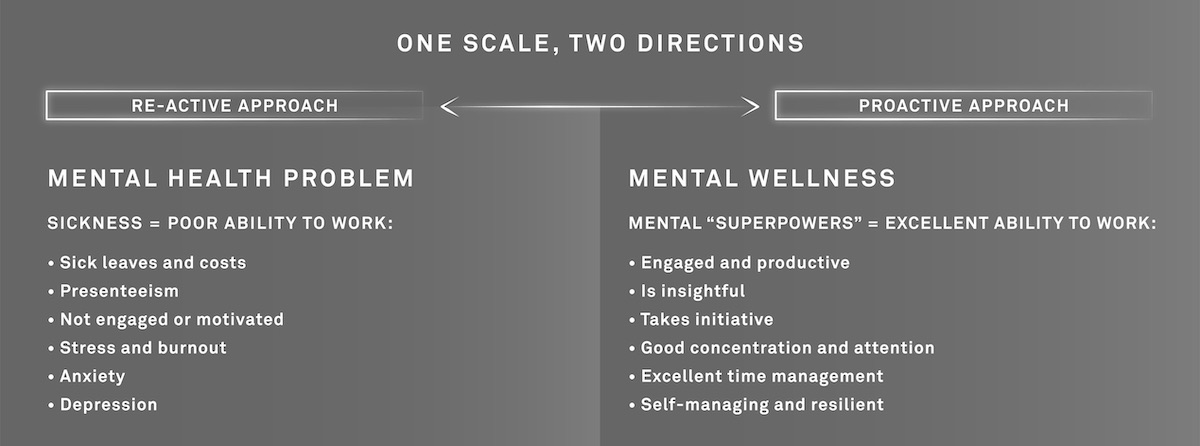
All trust is always earned. Earning trust takes time. When a leader has good mental wellness and is seen as calm and trustworthy, employees aim to follow.
In that sense, mental wellness spreads easiest from top down. Resilient leaders are more creative and intuitive. They are the ones who can earn trust.
Intuition thrives when leaders and professionals take personal responsibility for their inner environment and for their actions. No one else can organize your mental landscape for you.
You, as a person, are 100% responsible for the clarity you bring into a conversation, the steadiness you offer during uncertainty, and the focus you apply to each decision.
You may not like the previous sentence, but it is the foundational truth.
Responsibility equals inner freedom. It is what secures your conscious choice.
That is why absolutely everyone needs to learn intrapersonal skills.
You can’t use the skills you lack. We know it well on the professional level, but often forget it on the intrapersonal level, as we have had no intrapersonal education in our schools. Thus, we lack inner skills to keep our minds fit and free from stress and anxiety.
When you take charge of your inner domain, your intuition can start to function better, and your decisions are based on your ability to respond consciously.
Authenticity originated from leading your inner domain, which allows you to use your kindness and be fully present for those you have chosen as your co-creators.
The truth is simple: either you lead your inner world consciously, or the subconscious (automatic) inner reactivity masters and manages you to survive somehow. Survival isn’t thriving.
Remember, a calm, well-trained mind spots warning signs, reads complexity with ease, and leads with presence. A calm-minded person is the one who becomes the stabilizing presence people look toward, especially in uncertain periods.
It is your aware use of awareness, sensing, and intrapersonal skills that strengthen your presence and support healthier and more human-centric and life-preserving strategic and vision-based decision-making.
Conclusion
All intrapersonal skills can be learned. That is why training your mind matters.
The same intrapersonal skills that allow you to spot and reduce your reactive patterns allow you to reduce stress. Stress is just your subconscious inner reactivity.
By learning intrapersonal skills, you can start to choose how you respond. And when your mind is calm, you can also access creativity and insights with more ease. It demands practice.
Practice is what gives you confidence.
A calm-minded person can notice more than a person with a noisy mind. Until your emotions, imagination, and thoughts run wild, you remain subconscious and reactive. Until you remain in constant subconscious inner reactivity, you lack the inner freedom to access intuition, creativity, or insights
Getting off the subconscious and reactive autopilot mode is what allows you to become a conscious and intuition-trusting decision-maker.
Only when you calm your mind and become a master of leading your thoughts and imagination can you access intuition and creativity at will. Once you do, you, as a leader or qualified professional, are able to create an environment in which trust genuinely flourishes. As a side effect, in such an environment, work engagement rises, anxiety lowers, and performance strengthens.
By training your mind to remain calm and using intrapersonal skills, you elevate leadership and improve the resilience of yourself and your team.
|