

In the fast-paced world of today, where demands at the workplace are constantly increasing, comprehending how to keep away employee stress has become a crucial aspect of fostering a healthy work environment, as 9 out of 10 employees are stressed.
A proactive systematic approach towards proactive employee stress management remains the key to not only maintaining a cheerful atmosphere in the workplace but also enhancing overall productivity and well-being.
A calm and fit mind can focus, access creativity, and use intuition when needed. Those abilities are intrapersonal skills.
The fact is, we all can learn how to focus, maintain our focus as long as needed, and access creativity at will when we understand our inner domain better. Access to intuition demands that you know how to maintain a tranquil mind.
Our inner calmness is key to accessing many wonderful inner powers and dealing with stress.
What is proactive stress management?
Proactive stress management involves implementing preventive measures before stress takes a toll on an individual's mental and physical health.
Instead of waiting for stress to build up, the proactive mental wellness approach focuses on training the minds of employees while they are well. This is like going to the gym in case of physical health, only you train your mind. And in this sense, what we have developed for you is a mental wellness gym for teams.
When fit minds work together and foster a culture of well-being you can build a sustainable and healthy work culture.
The key here is dealing with inner problems before they cause damage and toxic interpersonal relations.
Training intrapersonal skills represents the key that allows you to handle stress before it becomes overwhelming. Separate short-term stress incidents aren't a problem, but those become a problem when worry and stress overwhelm you or continue for a long time.
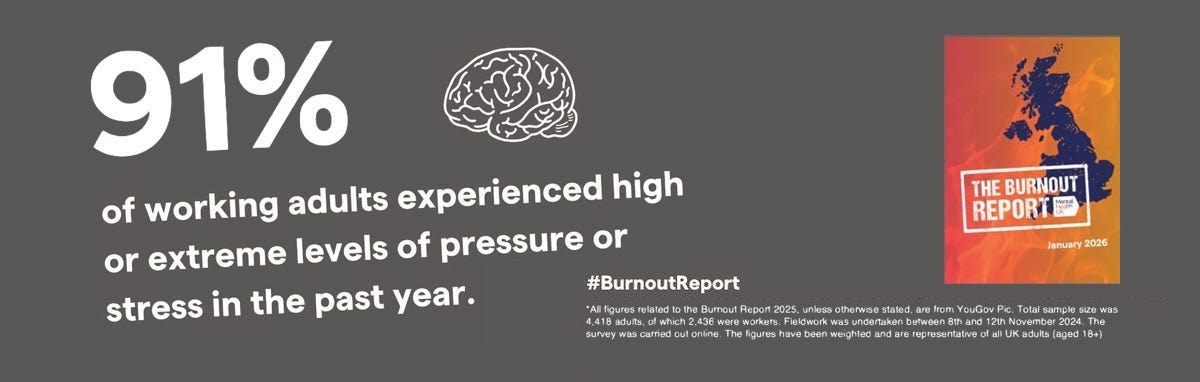
As you can see from the 2026 UK Burnout Report, the problem is huge, as 91% of adults experienced high pressure in the past year.
Stress and burnout connection
Chronic stress and positive stress lead to burnout and several physical health issues, and lead to a drop in productivity and employee engagement levels.
The most effective way to achieve pro-active stress management is by training the mind while individuals are still well. This involves incorporating mental wellness training practices into the daily routine. By training the mind to stay present and focused, employees can better cope with the challenges that arise in the workplace.
While mindfulness and meditation are also great approaches for stress reduction, practicing those are harder to apply in actual fast-paced work situations. Hence, people in the workplace need practical intrapersonal skills that they can use with open eyes while working. Using our awareness of awareness in an active form at work has many benefits over passive consciousness practices.
Awareness allows you to spot your inner reactions. When you notice your inner reactivity, you can learn to change it.
Comprehending the difference between subconscious or instinct-based inner reactivity and replacing it with an aware response is something that the Wellness Orbit online training 'Performing Under Pressure' focuses on (click on the link to find out training details).


According to the 2019 Cigna survey, 91% of employees state that their colleagues' stress impacts their work results. So, stress impacts not only your mind but also the people around you.
The benefits of training your mind extend far beyond stress reduction. There is also a clear business sense.
Proactive mental wellness training enhances your cognitive functions and improves concentration and access to creativity, which we now, in the era of AI, need more than ever. It also fosters an optimistic outlook. These benefits not only contribute to a healthier work environment but also translate into improved job performance, employee engagement, and work satisfaction.
Implementing proactive employee stress management programs can also result in a reduction in absenteeism and employee turnover.
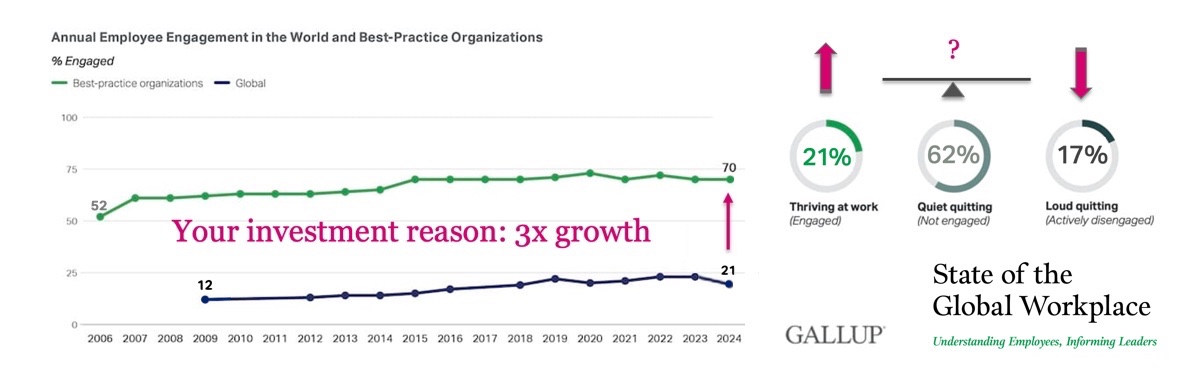
When employees feel supported and equipped with the tools to manage stress, they are more likely to stay engaged and committed to their roles. Thus, in the best practice organizations, you can notice around 3 times more engaged employees than in usual workspaces, according to Gallup's employee engagement trends study in 2025 (see the graph below).
When stress levels become problematic, and employees burn out, they tend to leave the workplace where they experienced burnout. Many also shift their professional career and abandon the corporate world, and seek a slow-paced lifestyle.
Employee burnout costs range from $3,999 to $20,915 (3,333€ to 17,429€ or £2,999 to £15,686) per person, depending on the position, according to the scientific paper 'The Health and Economic Burden of Employee Burnout to U.S. Employers' published in April 2025 by the American Journal of Preventive Medicine.
As the final phase of burnout has 82 to 86% overlap with depression, stress reduction is also the key element to a work-related mental illnesses prevention strategy.
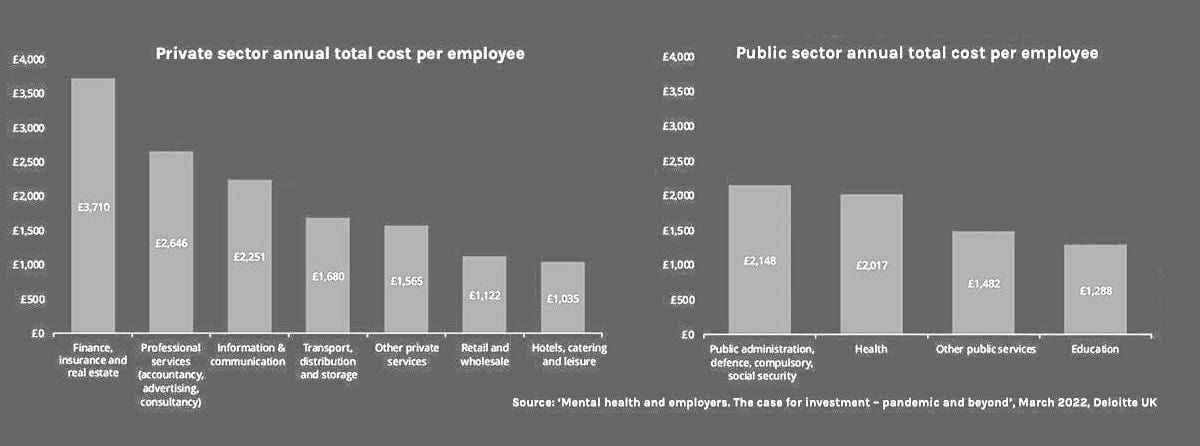
So, if stress is not dealt with in time, it leads to more damage than meets the eye. Thus, Deloitte UK calculated in 2022 that the annual loss from negative mental health problems per employee can be as high as £3,710 ($4820 or 4,120€; see the graph below).
The fundamental starting point of work-related mental health problems is stress, and predominantly positive stress.
Unfortunately, positive stress is often glorified and praised as something that improves productivity. Such improvement is always short-lived, and that is why we hear so much about burnout and toxic work culture.
It is time to handle stress the same way as physical tensions. You either learn to relax or train your body to overcome those. The same is true in the case of your mind; stress training should be relaxing and additionally allow you to improve your mind health.
.jpg "Enjoy a free stress test!")
A fit mind is sharp and enjoys solving meaningful challenges. When you combine stress reduction training and allow people to perform meaningful work, success can follow.
Conclusion
Understanding how to keep away employee stress is integral to maintaining a thriving workplace.
Proactive stress management, especially through training the mind while individuals are still well, can lead to a positive work culture, increased productivity, and overall employee satisfaction.
Investing in the stress reduction and mental well-being of employees is an investment in the success and longevity of any organization that can bring tenfold ROI.