
Why 91% of Employees Face High Stress and How Leaders Can Respond?
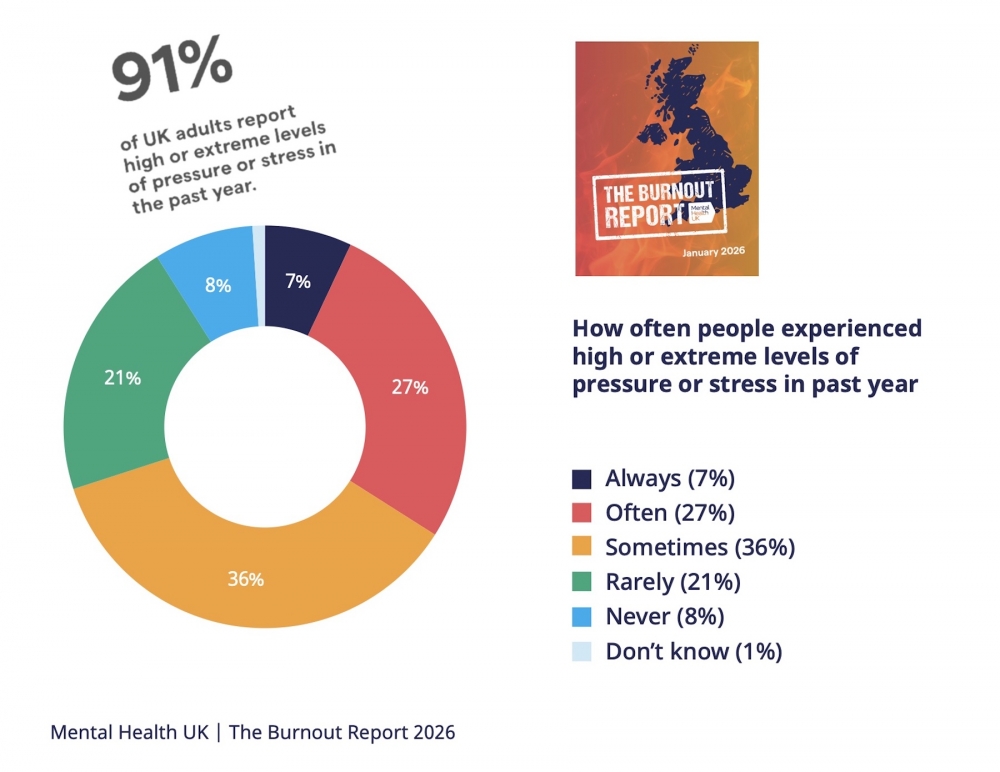 Data from the 2026 UK Burnout Report
In 2026, burnout still causes problems for leaders, top professionals (lawyers, doctors, nurses, compliance officers, etc.), and mostly for younger employees. Before we open up the newest data, let us remind you that burnout is 100% preventable.
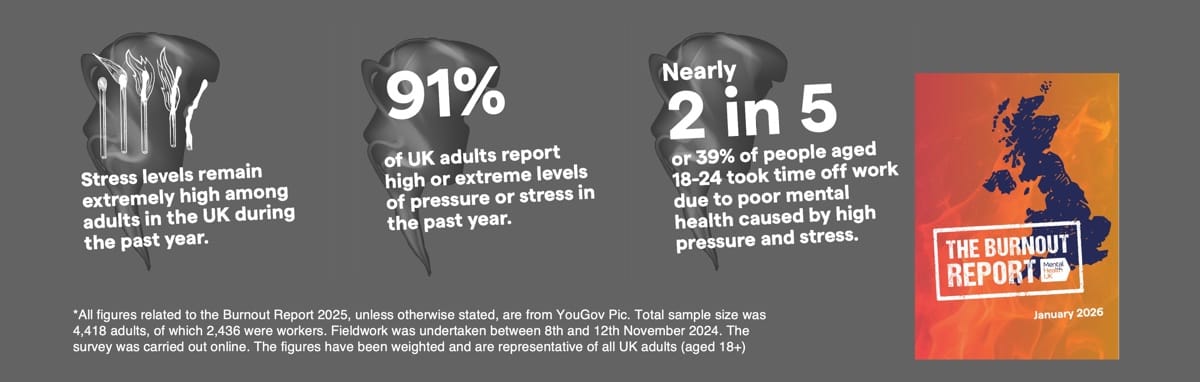
The UK Burnout Report 2026 comes up with a significant finding that age is now a stronger predictor of burnout than some job titles. Mental Health UK, report from January 2026 found that 91% of adults experienced high pressure last year.
The report also stated that 39% of young workers (Gen Z aged 18–24) took time off work due to poor mental health caused by high pressure and stress.
The Burnout Report reveals the risk of burnout remains stubbornly high, with 9 in 10 adults experiencing high or extreme levels of pressure and stress during the last year. It appears that at the same time, the discomfort around discussing problematic stress and pressure levels in the workplace demonstrated no actual improvement from previous years.
35% of the surveyed workers and 39% of young workers (aged 18-24) reported not feeling comfortable discussing high or extreme levels of stress with a manager.
According to the report, workers are being put at risk of burnout relapse and sustained work absence, with some employers failing to provide adequate recovery support.
27% of employees who took time off due to extreme levels of pressure or stress stated in answers that they didn't receive any support after returning to work, and only 17% had a formal return-to-work plan put in place.
Furthermore, 18% of the employees said mental health is treated as a tick-box exercise at work. The good news is that 27% stated that mental health is genuinely prioritized and supported through action and resources.
What it means is that prevention of burnout has to transition now from a peripheral human resources initiative to a core strategic imperative. Otherwise, you keep losing your best talent.
Do we see a change this year? To be honest, it depends on you!
5 Systemic Measures to Safeguard Performance and Reduce Burnout
To start the shift, leaders need to recognize that personal sustainability and mental wellness are the bedrock of organizational performance.
To mitigate psychosocial risk factors, such as chronic work overload, low job control, and poor social support, leaders need to move beyond just formally adopting measures that improve the work environment and overextended work design.
Next, to answer the question in the title, we outline five ways that enable leaders to respond healthily and address burnout before it takes hold.
1. Strategic Job Redesign and Resource Alignment
Caring leaders are finally looking beyond surface-level wellness perks and shifting the focus to giving people more control, securing mental wellness training, and reducing psychosocial risk factors (something that is demanded by law in many countries).
This approach involves identifying and eliminating the biggest hazards in the work environment and work culture. Regular audit of employee workloads and redistributing tasks based on capacity indeed helps leaders prevent chronic overload among their staff.
When work roles are clearly defined with achievable goals set, cognitive fatigue can be reduced. Using predictive analytics to anticipate high-pressure cycles and proactively inject additional resources or adjust timelines before the team reaches a breaking point is a very efficient approach.
2. Cultivating Psychological Safety
Creating a supportive culture requires that leaders understand the essence of psychological safety, can listen, and identify vulnerability without blame.
When a leader openly acknowledges their need for rest or admits they experience pressure and professional challenges, it fosters genuine open-mindedness and reinforces the importance of mental wellness. Real rest, restoring inner peace, and learning intrapersonal skills to deal with challenges matter here more than fixing the environment.
To attract and retain qualified professionals, a high-quality work environment is essential. However, if healthy working relationships, effective workload management, and intrapersonal skills training are lacking, external psychosocial safety measures alone can't deliver lasting improvement.
Stress and burnout are mainly about inner reactivity, so mental wellness training is the core competence that most people lack and therefore need ASAP. Recognizing that, besides work, external societal or personal stressors significantly impact workplace presence matters as well.
We all have one life, and integrating all aspects of life by using intrapersonal skills is what secures mental wellness and the ability to thrive with work tasks.
3. Enforcing Digital Boundaries
As hybrid and remote work models continue to blur the lines between professional and personal life, leaders have now noticed the need for boundary management.
Rather than simply suggesting work-life balance, it needs to be the integration of life and work. We all need time to rest, and being online 24/7 hinders it.
Screen-free zones in libraries are increasingly being introduced so people can focus calmly on reading and quiet study. We strongly recommend creating silent, screen-free relaxation and coffee-break rooms. While in the first, you can relax, in the second, face-to-face interaction can thrive.
Before the era of constant digital devices, rest, calmness, and personal connections were more deeply valued.
The Right-to-Disconnect protocol should be considered if this can't be secured naturally. Pinging colleagues after hours is something that needs to be avoided (calling after business hours should be for extreme emergencies only). By making it the norm that no one needs to be 'always on', leaders protect the cognitive recovery time essential for keeping good health and sustaining access to creativity through inner silence.
4. Promoting Autonomy and Human Value
A primary driver of burnout is the feeling of being a 'cog in the machine'. When people are seen as biorobots, they fail. If your thinking needs to be machine-like, AI probably does your job better.
However, if access to creativity, taking initiative, allowing intuition to guide you, and being innovative are valued, people still (could) have a huge upper hand over AI (on the link, there is one of our most-read blogs).
While AI excels at rapidly combining and analyzing vast amounts of data, it doesn't possess lived experience, self-awareness, or access to genuine human insight. AI recognizes patterns and generates outputs based on existing information, but it doesn't understand meaning or creativity in the human sense.
Human strength still lies in intuition, ethical judgement, accessing creativity through inner silence, and grounded professional experience. This is what secures human ability to generate truly original perspectives shaped by consciousness, sensing, and being present and deeply understanding the actual context.
Increasing human agency means providing your team members with control over how, where, and when they work. Whether through flexible scheduling or project-based autonomy, giving employees a voice and self-leadership skills that secure conscious decision-making significantly lowers cortisol levels and increases job satisfaction.
If you need automation, precision, and scalable efficiency, use robots, software programs, or AI solutions. These tools are designed to process data, execute repetitive tasks, and operate with speed and consistency. They are powerful assets when accuracy and volume are the priority.
However, when you need human connection, passion, dedication, and ethically grounded responsibility, rely on people. Humans bring empathy, moral judgment, contextual and self-awareness, and the ability to navigate nuance.
Humans are the ones who earn trust, inspire others, and make decisions that consider long-term impact beyond immediate metrics.
The most effective organizations understand the distinction: leverage technology for efficiency, and empower humans for leadership, creativity, and meaningful accountability. Let humans have their autonomy and make it understood that responsibility equals freedom.
5. Prioritize monotasking
Recognizing that constant multitasking is a major stressor is what allows leaders to prioritize designated deep-work blocks without external interruptions.
Besides this, the main problem is internal interruption. When you are not fully present in your body and your mind wanders, work still gets interrupted. When thoughts, imagination, emotions, desires, fears, and anxiousness run on autopilot mode, it is hard to focus on any task.
Doing one thing at a time without interruptions is what makes all the difference. Dr. G. Mark from the University of California pointed out that when interrupted, on average, it takes 23 minutes for a person to refocus. Her study demonstrated that 45% of the time, distractions occur by self-interruption via internal factors.
Getting things done is a learnable art; it starts with self-leadership and understanding how to keep focus. Luckily, we have an e-training for this (see the link below). Leading your awareness and sensing at will, while seeing the big picture and monotasking to solve actual needed details at the moment systematically, is what allows thriving.

The Power of Awareness
Ultimately, the essence of securing mental wellness proactively lies in awareness and using awareness-based intrapersonal skills. That is why training your mind is a must.
Everyone needs to learn to recognize the early signs of chronic stress and burnout as early as possible. Here, self-observation and self-awareness are the precursors to healthy and purposeful action.
When people embrace the importance of inner silence, being human, taking responsibility, and possessing excellent intrapersonal skills to deal with external stressors, they fuel the capacity to do work that matters. All those aspects sustain life and personal relationships as well.
Thriving at work is only possible when a person is thriving in life. Hardships are not the problem; failure to deal with pressure calm-mindedly is.
A calm-minded person is rare these days, but it is the calm mind that keeps us in the leadership positions, be it leading a family, a small project team, or a huge team that competes on the open market with other businesses.
These days, the strongest competitive advantage is not AI alone or the ability to process vast amounts of data. It is a calm, mentally fit human being who uses awareness consciously and makes fully informed conscious decisions, even when under pressure.
Such a person knows how to monitor stress and burnout risk levels and use intrapersonal skills. The question is, are you aware of your stress level? Measure it right now for free and enjoy a demo training as a bonus.
.jpg "Take a personal stress test and enjoy feedback!")
Final Outlook
Organizations that will outperform others are those that cultivate work cultures where people feel supported, trusted, and empowered.
When autonomy, responsibility, and collaboration are embedded in a genuinely human way, employees can become less reactive and more proactive.
The Burnout Report urges: „Use employee feedback to identify pressure points and adjust policies or workloads as needed, recognizing an employer’s accountability for the workplace factors contributing to burnout.“ However, without intrapersonal skills, people can't notice the growth of their stress level and the piling up of burnout risks.
Both mental wellbeing securing work policies and mental wellness trainings at the individual level are a must to prevent burnout.
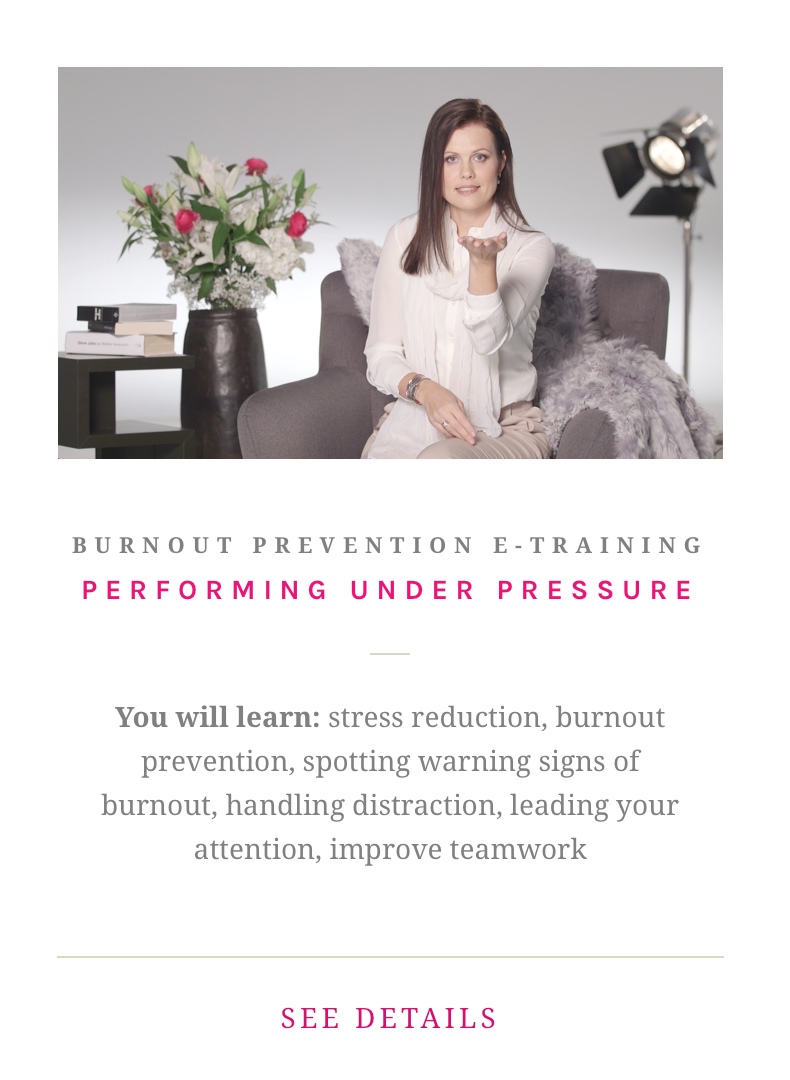
The report recommends surveys to identify pressure points and set a personal development plan. This, on the individual level, is something that our training, 'Performing Under Pressure', allows as it includes self-evaluation tests on stress levels and burnout risk, and provides a workbook that allows one to create a personal wellbeing monitoring and restoration plan.

Learning intrapersonal skills for self-leadership reduces burnout risk, strengthens engagement, and improves decision quality.
When people feel psychologically safe and respected, they take ownership and are more confident. When they also have good intrapersonal skills, they can monitor themselves. Stress and burnout risk reduction is something everyone can learn on this website (click on the link above and find out more).
Sustainable success will belong to companies that combine technological capability with mentally resilient, self-aware professionals operating in cultures where trust is earned and human dignity valued. It is up to leaders to show the way of earning trust and keeping their own minds fit and well. Then their staff can follow the leader's own example. As a leader, train your own mind, and invite others to do the same!
|
This burnout blog post was shared by Kaur Lass