

Why Self-Leadership and Stress Reduction Drive Engagement and Performance
 Invest in yourself and your people
By this World Mental Health Day, the data is clear: workplace mental wellness is both a health and a performance issue.
Recent 2026 figures show that approximately 9 in 10 workers still experience high pressure or stress at least some of the time, and nearly half of Gen Z and millennial employees report feeling burned out.
Work Right Campaign page reports “An estimated 964,000 workers in Great Britain are experiencing work-related stress, depression or anxiety, resulting in 22.1 million working days lost. These conditions account for 52% of all work-related ill health and 62% of all working days lost due to work-related ill health”
Globally, low employee engagement has fallen to around 20% and is estimated to cost the world economy roughly $10 trillion in lost productivity.
The findings from Vitality’s Global Health and Productivity Index 2026, conducted by FGS Global and RAND Europe across five markets, pointed out that in Germany, workers lose an average of 69.3 days and US workers 63.4 days to poor physical and mental health, while the five-market average number was 54.8 days.
This study pointed out that traditional absence tracking captures roughly one in seven days of actual health-related productivity loss. This means around 85% of that loss occurred while people are still at work, operating below capacity.
Absenteeism is visible while presenteeism quietly erodes quality, creativity, and collaboration.
Autonomy, Stress and Relaxation Connection
Employees with autonomy experience more control over how and when they work based on their own preferences and feel a part of their organization’s daily decision-making processes.
When employees work with leaders who support their autonomy, they feel higher job satisfaction and less pressure on their mental wellbeing. Transparent communications and supportive leadership practices are often associated with trust, employee appreciation, and the psychological safety that people experience.
According to the 2024 Mental Health America (MHA) report Mind the Workplace, only 47% of the surveyed US employees agreed that their employer encourages clear and transparent communication. This number was 92% in healthy workplaces and 8% in unhealthy workplaces. It shows that work culture, as well as the opportunity to train your mind to improve psychological safety, matters.
According to the MHA report, overall, 57% of employees agreed they felt a sense of belonging in their workplace. However, while 97% of employees in healthy workplaces agreed with this statement, only 9% of employees agreed with it in unhealthy workplaces (see the graph below). So, toxic relations, stress, and experiencing health issues spoil belonging and contributing.
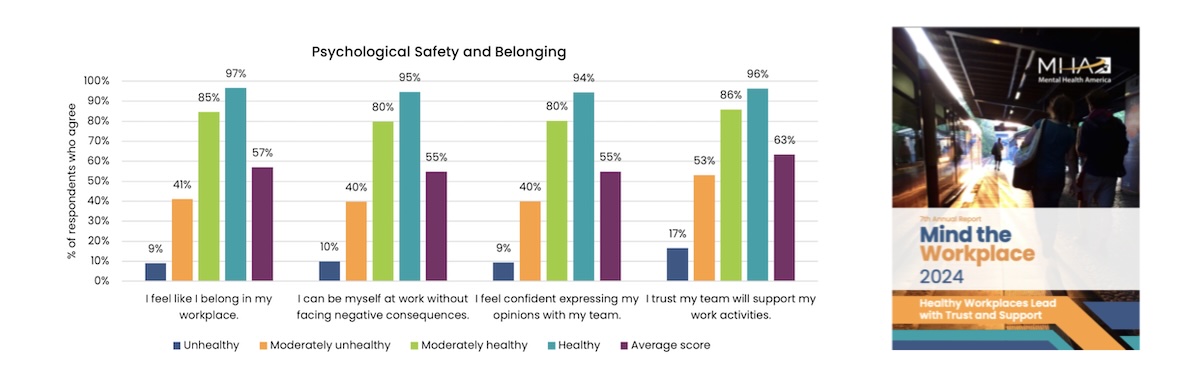
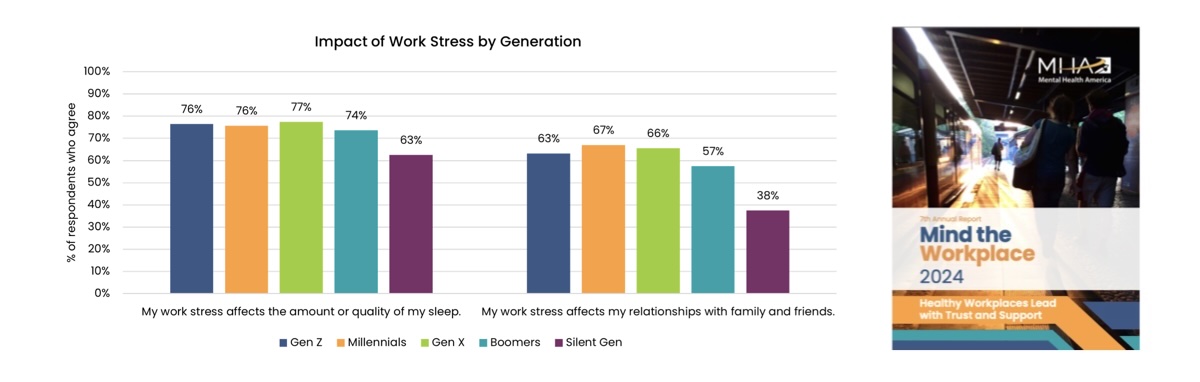
The same MHA report pointed out that work stress has a strong impact on how employees sleep and experience personal relationships. 90% of employees in unhealthy workplaces agreed that work stress has a strong impact on those two factors, while the number was 44% in healthy workplaces. On average, 76% of employees agreed that work stress affects their sleep.
The generational variations of stress effect on sleep and relations can be seen in the graph below.
If people don’t rest well, they can’t work well. It is that simple. A stressed mind just can’t focus and be productive, as the problems within the mind are closer and stronger than the challenges around them. When the mind is under pressure, work suffers.
From Reactivity to Intrapersonal Skills Based Leadership
Traditional mental health approaches often deal with people who are already struggling. A more effective path is proactive mental wellness built on intrapersonal leadership.
Intrapersonal skills give people the capacity to notice changes in their own inner states early and also allow self-regulation. This allows them to spot and reduce unnecessary reactivity that leads to stress, burnout, and mental health issues.
However, investing in practical intrapersonal skills gives back more, as responding consciously not only secures better inner calmness and more aware health-related decisions but also allows people to access creativity, intuition, and insights more easily.
When people train intrapersonal skills, they become better able to distinguish external pressures and stressors, such as deadlines, workload, and uncertainty, from their own internal reactions to those stressors.
Removing subconscious inner reactive patterns is what allows people to reduce chronic stress before it escalates into burnout.
Improve Engagement and Conscious Decision Making by Uplifting Mental Wellness
Calm, fit-minded employees and leaders demonstrate higher engagement, more conscious leadership, and take time to relax and restore. They dare to say no and seek meaning in the work they do.
Doing meaningful work in a well-organized workplace is what matters and makes a huge difference. Fit-minded people need to understand their role, and they demand good leadership. In return, they give their dedication to the worthy cause.
Organizations that support this shift by giving their teams access to training on how to use awareness and intrapersonal skills allow people to learn constructive responses.
The ability to respond is light and empowers people when it is understood correctly as a conscious choice.
Lack of consciousness during decision-making reduces people to subconscious bio-robots, while responsibility, as a conscious choice, equips them with the inner power to understand what is needed, relevant, healthy, and economical at the same time. This becomes even more important now, when humans need to find their way to co-exist with AI solutions.
When intrapersonal skills are used with ease, stress can be reduced, communication improved, and organizational matters solved in a more involving and caring way.
Stress reduction combined with healthy work conditions and patterns allows people to sustain contribution without burning out.
Taking a break is seen in such workplaces as an investment, not an expense or laziness.
All creativity, intuition, and insights demand inner calmness and mental pause. Short pauses, as well as longer breaks and holidays, allow this.
Mental Wellness is an Investment, Not an Expense
Proactivity in solving work and securing health becomes easier when it is supported by clear feedback and autonomy rather than adding extra pressure.
Studies commonly show returns in the range of £3–£4 (or $3–$4) for every £1/$1 invested through gains in productivity, reduced absence, lower healthcare costs, and better retention. This sounds good, however, skills-based workplace-wide mental health and wellbeing investments deliver even better returns.
According to Deloitte UK report, effective mental health and wellness initiatives deliver an average return of £4.70 for every £1 spent through increased productivity, reduced absenteeism, and lower absence. However, combining workplace-wide and proactive training programs can demonstrate ROI, which can be up to 10,8.
Such high-level ROI points out that investing in proactive mental wellness training accessible to all is one of the highest-return business decisions leaders can make.
The gains appear not only in improved health but also in higher engagement, fewer stress-related absences, reduced presenteeism, and stronger retention of talent. Ignoring stress, burnout, and mental health problems carries a clear cost; acting early protects both people and performance.
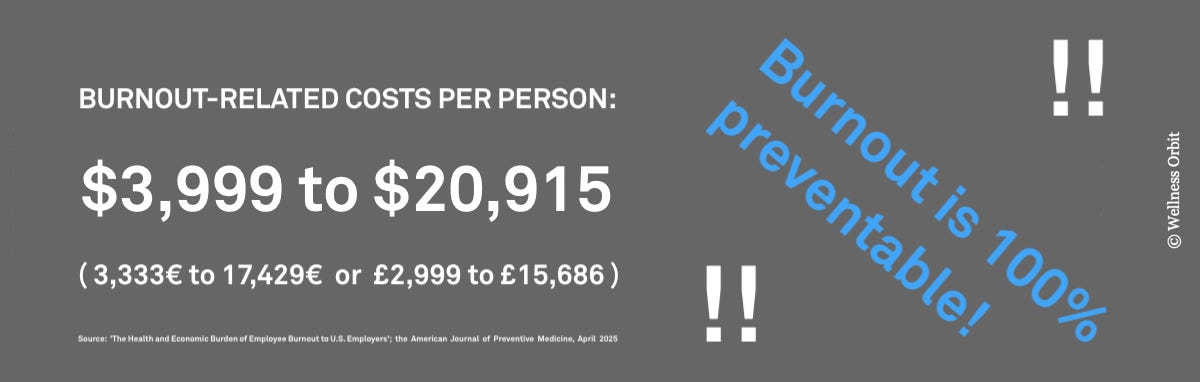
For example, costs related to burnout per person range from $3,999 to $20,915 (3,333€ to 17,429€ or £2,999 to £15,686), according to the scientific paper 'The Health and Economic Burden of Employee Burnout to U.S. Employers', published in April 2025 by the American Journal of Preventive Medicine.
A Practical Call This World Mental Health Day
World Mental Health Day makes sense for employers and employees if it is seen as an opportunity to take action to reduce stress and burnout and improve overall mental wellbeing.
Organizations that treat mental wellness as a strategic capability and equip people with excellent intrapersonal leadership skills become better at designing work in ways that can improve engagement and human relations.
A systematic, proactive mental wellness approach is a powerful way to reduce the twin drains of absenteeism and presenteeism while also improving access to innovation. Intrapersonal skills are more than health-securing skills; they also improve access to creativity, intuition, and insights, as well as support keeping focus and conscious action.
Sustainable performance depends on minds that are fit and can stay calm and engaged under pressure. Investing in mental wellness training for your staff is one of the highest-leverage actions leaders can take.
|
This blog post is shared by Kaur Lass